How to Choose a Landscaper in Scotland: What to Look For Before You Sign Anything
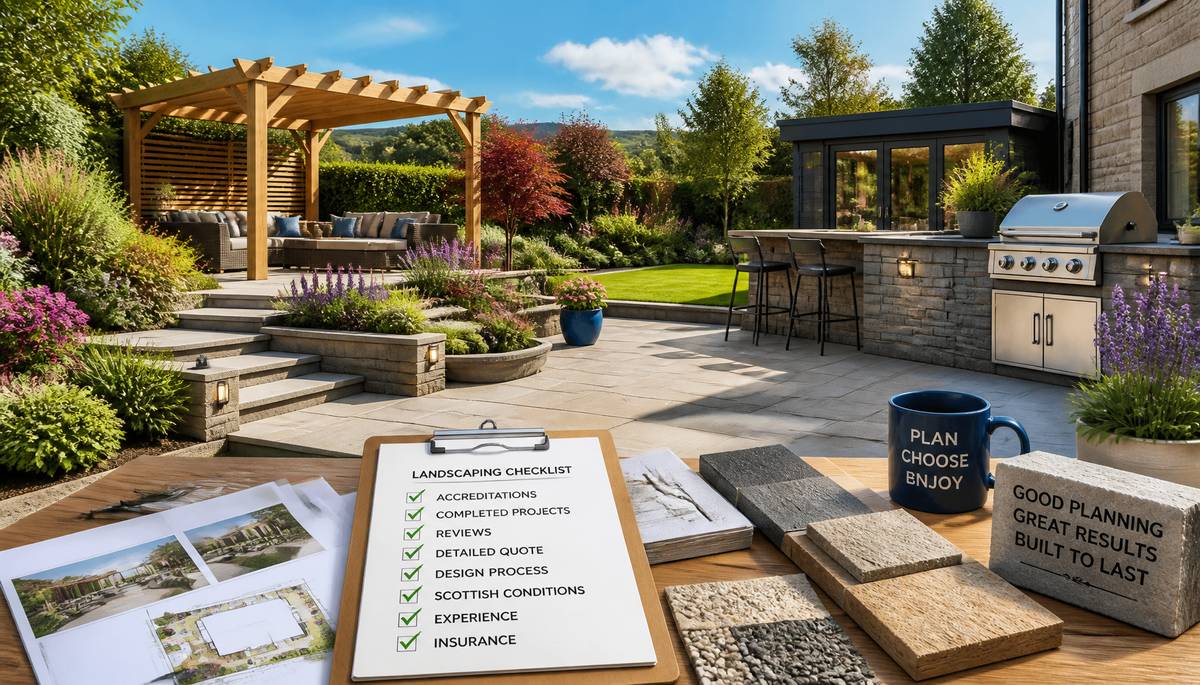 Choosing the wrong landscaper is an expensive mistake. Unlike a bad haircut, it doesn't grow back in six weeks. Poor groundwork, badly specified materials, or a contractor who disappears halfway through the job can leave you with a garden that costs more to fix than it would have to do properly from the start.
Scotland has no shortage of people offering landscaping services. Finding a good one takes more than a Google search and a look at some photos. Here's what to actually check before you commit.
Verify Their Accreditations
This is the first filter, and it removes a lot of names from the list quickly.
Reputable landscaping companies in Scotland hold recognised industry accreditations. Look for membership of the British Association of Landscape Industries (BALI) or accreditation from the Association of Professional Landscapers (APL). These aren't just logos on a website. Both organisations require members to demonstrate competence, carry appropriate insurance, and adhere to codes of conduct. They also offer dispute resolution if things go wrong, which is worth more than you might think.
Beyond industry bodies, check for health and safety credentials. SafeContractor certification and SMAS Worksafe accreditation indicate that a contractor has been independently assessed for their approach to safe working. For any landscaping project involving groundwork, machinery, or structural elements, this matters. Landscaping is a physically demanding industry with real safety risks; a contractor who takes health and safety seriously on site is also one who takes quality and professionalism seriously.
ISO accreditation is less common in landscaping but worth noting when you see it. ISO 9001 covers quality management systems. ISO 14001 covers environmental management. A company holding both has been externally audited against international standards, which is a meaningful signal.
Companies like MacColl & Stokes Landscaping hold multiple accreditations including SafeContractor, SMAS Worksafe, and ISO certification, as well as approved installer status with major paving manufacturers like Marshalls and Tobermore. That kind of portfolio takes years to build and is not something a new or low-quality operation will have.
Look at Completed Projects, Not Just Photos
Every landscaping company has photos. The better question is whether those photos show work in your area, at your scale, and of the type you're planning.
A contractor who specialises in large commercial grounds maintenance may not be the right fit for a residential garden redesign. One whose portfolio shows mostly lawn care and planting may not have the hard landscaping experience needed for a project involving significant groundwork, levels, or structural features like retaining walls and steps.
Ask to see projects similar to yours. If you're planning a full garden redesign with a patio, a pergola, and planting, look for examples of each in their portfolio. If you want an outdoor kitchen or a garden room, check they've actually built them before, not just that they say they offer the service.
Project galleries on a company's website give you a starting point. Visiting a completed project in person, with the client's permission, tells you considerably more. You can see how the materials have weathered, whether the construction has held up, and how the garden actually functions as a space.
Check Reviews Carefully
Online reviews are useful, but they need to be read with some thought.
A company with forty reviews averaging 4.9 stars over five years tells a different story from one with six reviews averaging 4.9 stars over six months. Volume and consistency matter. Look for reviews that describe the process, not just the outcome. "Great garden" is less useful than "they kept us informed throughout, dealt with an unexpected drainage issue without fuss, and finished on time."
Pay attention to how a company responds to any negative reviews. A defensive or dismissive response to a complaint is a red flag. A calm, constructive response that acknowledges the issue and describes how it was resolved tells you more about how they'll handle problems on your project.
Google reviews, Checkatrade, and Trustpilot are all worth checking. For Scottish landscapers specifically, look for reviews that reference local projects and local conditions. A company praised for their work in Glasgow or Central Scotland by multiple reviewers over several years is a different proposition from one with no local track record.
Understand What the Quote Includes
This is where most misunderstandings happen, and where you need to be precise.
A detailed, itemised quote is the minimum you should accept. It should specify materials by name and grade, quantities, the scope of groundwork, any drainage work, how waste is removed, and what happens if unexpected issues arise during the dig. Vague quotes that reference "groundwork as required" or "materials to be agreed" leave too much room for cost to increase after work has started.
Ask specifically about the sub-base specification for any hard landscaping. The sub-base is what everything sits on, and it's what's most likely to be cut short by contractors who are competing on price. A proper sub-base for a patio or driveway involves excavation to the right depth, compacted hardcore to the correct specification, and in many cases a concrete or MOT type 1 layer before any surface material goes down. What's underneath determines whether the surface lasts five years or twenty-five.
Get at least three quotes. Not to find the cheapest, but to understand the range and to identify what different contractors are and aren't including. If one quote is significantly lower than the others, ask exactly what it excludes. The answer will usually explain the difference.
Ask About Their Design Process
For anything beyond a straightforward single-element job, a structured design process is a good sign.
A landscaper who asks to visit the site, spends time understanding how you use the garden, assesses soil and drainage conditions, and then produces concept plans and scaled drawings before any work begins is one who understands that good landscaping starts with good planning. One who offers to start the following week after a twenty-minute visit is one who's working from assumption rather than assessment.
3D visualisation has become more common in residential landscaping and is worth asking about for larger projects. Being able to see a realistic representation of the finished garden before groundwork begins lets you make changes on paper rather than on site, which is always cheaper and less disruptive.
Ask how they handle changes to scope during the project. On any significant landscaping job, something unexpected will arise: a drainage issue, a change of mind about a feature, a material that's unavailable. A good contractor has a clear process for handling variations, communicating the cost implications, and getting your approval before proceeding.
Think About Experience in Scottish Conditions
This matters more than it might seem.
Landscaping in Scotland involves conditions that are genuinely different from other parts of the UK. Freeze-thaw cycles cause more structural damage to hard landscaping than simple rainfall. Persistent damp is harder on materials than occasional wet weather. Prevailing south-westerly winds affect how gardens are planted, how outdoor structures are positioned, and how much use you'll actually get from an outdoor space unless it's properly sheltered.
A landscaper with deep experience of working in Central Scotland, the Glasgow area, or similar climates will specify materials and drainage differently from one whose experience is primarily in drier, milder parts of the country. They'll know which stone products hold up to frost, how to detail a patio edge to prevent water ingress, and how to position an outdoor kitchen or seating area to make it genuinely usable for more than three months of the year.
Ask how long they've been working in the area. Ask about specific challenges they've encountered with local soil conditions or weather, and how they've addressed them. The answers will tell you a lot about the depth of their knowledge.
Don't Rush the Decision
A good landscaper will not pressure you into a quick decision. They're usually booked weeks or months in advance and have no need to.
If a contractor is pushing hard for you to sign before you've had time to check their references, see their previous work, and compare quotes properly, treat that as a warning sign. The urgency is theirs, not yours.
The time you spend choosing the right contractor is the best investment you'll make in the project. A landscaping job done well by a skilled, experienced, properly accredited company is something that adds real value to your home and that you'll use and enjoy for years. One done badly, or left half-finished by someone who took the deposit and moved on, is a problem that takes years and significant cost to resolve.
Take your time. Check everything. And when you find the right company, the rest of the process is considerably more straightforward.
|
|