Why a Slow Drain Can Be More Useful Than a Completely Blocked One
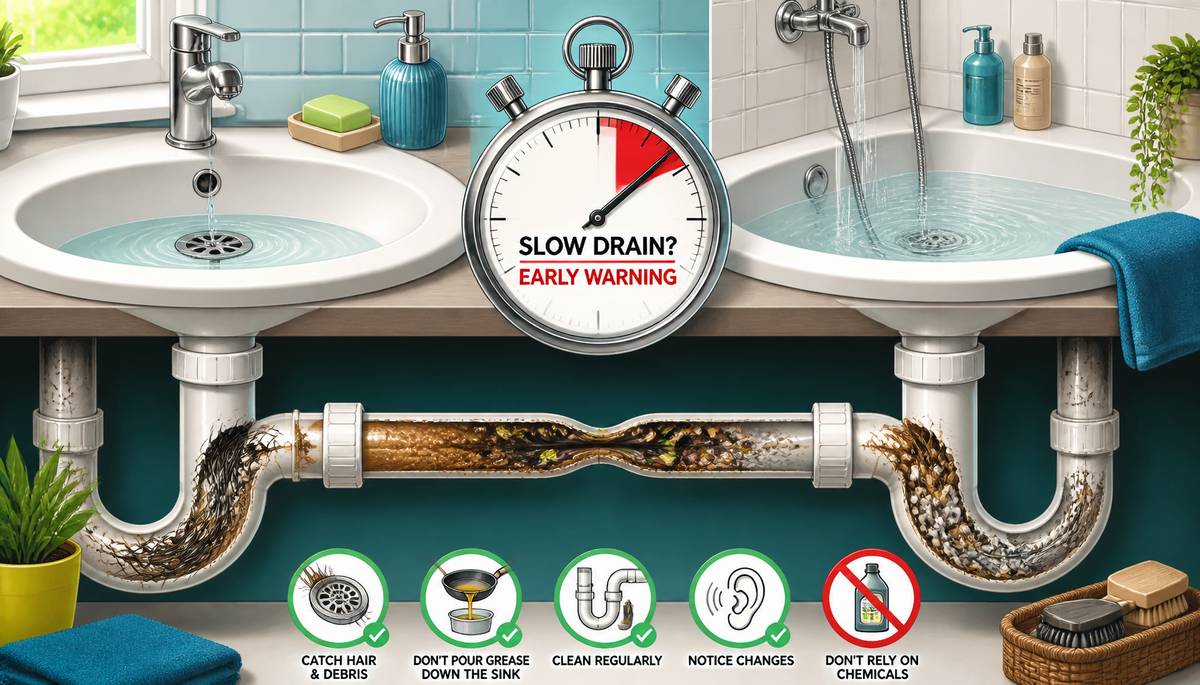 A drain that takes an extra thirty seconds to empty may be irritating, but it is also doing you a favour. Unlike a completely blocked pipe, which tends to announce itself with all the subtlety of a fire alarm, a slow drain gives you advance notice. Something is beginning to restrict the flow, and there may still be time to deal with it before the sink becomes an accidental indoor pond.
Gradual changes are easy to ignore. A bathroom basin that once emptied immediately might begin leaving a shallow pool around the plughole. The shower tray may remain wet for a minute after the water is switched off. A bath might develop an increasingly leisurely approach to emptying itself. None of these seems particularly urgent, which is precisely why developing drainage problems can remain unnoticed for weeks or months.
What Is Happening Below the Plughole?
Most slow drains are caused by material gradually accumulating inside the waste pipe. Rather than one dramatic obstruction, the internal diameter of the pipe becomes progressively narrower. Water can still escape, but there is less room for it to do so.
In bathrooms, hair is an obvious culprit, particularly when it combines with soap residue, skin oils and other material. The resulting mixture can cling stubbornly to the inside of pipework. It is not the most glamorous substance produced by civilisation, but it is remarkably effective at building its own little infrastructure.
Kitchen sinks have their own collection of offenders. Fats, oils and grease can enter the pipe as liquids before cooling and sticking to its interior. Small fragments of food then become attached to the greasy layer. Over time, the deposit grows and water has to squeeze through an increasingly restricted passage.
Sometimes the cause lies farther along the drainage system. Scale, accumulated debris, poorly flowing pipework or a developing obstruction in a shared waste pipe can all affect drainage speed. If several fixtures begin draining slowly at roughly the same time, the problem may therefore be more significant than a little hair beneath one plughole.
Timing Can Tell You Quite a Lot
Paying attention to how a fixture drains can provide useful clues. If water initially disappears normally but begins backing up after a tap has been running for a while, the pipe may be capable of handling a small volume but unable to cope with sustained flow.
Gurgling noises are worth noticing too. They can occur when air is being displaced unusually through the drainage system. An occasional gurgle is not necessarily evidence of impending plumbing catastrophe, but persistent changes in sound combined with slower drainage deserve attention.
Smells can provide another warning. Material accumulating inside a waste pipe may trap organic matter and produce unpleasant odours. At that point, spraying something vaguely reminiscent of an Alpine meadow around the bathroom is addressing a very different problem.
Early Action Is Usually the Easier Action
A slowly developing restriction is generally easier to investigate than a pipe that has become completely obstructed. Visible hair around a shower or bath waste can be removed before it travels farther into the system, while sink strainers can prevent larger pieces of debris entering kitchen pipework.
Being careful about what enters a drain matters just as much. Cooking fats and oils should not routinely be poured down the sink, even when followed by hot water. Once farther along cooler pipework, grease can solidify and contribute to deposits that become progressively harder to shift.
A slow drain is therefore less of a failure than an early-warning system. The water is still disappearing; it is simply taking long enough to suggest that something has changed. Paying attention at that stage can prevent a minor inconvenience from graduating into the considerably less entertaining spectacle of water refusing to go anywhere.
Why Chemical Cleaners Are Not Always the Answer
When a drain starts slowing down, reaching for a bottle of chemical drain cleaner can seem like the obvious solution. Pour, wait, rinse and admire the return of civilisation. Sometimes these products do improve the flow, particularly when they break down some of the organic material contributing to a restriction.
The difficulty is that improved drainage does not necessarily mean the underlying obstruction has disappeared. A chemical cleaner may create a channel through accumulated material without removing all of it. Water begins flowing more quickly again, everyone declares victory, and the remaining deposit quietly gets back to work.
Repeatedly using powerful drain cleaners can also be problematic. Different products contain different chemicals, and inappropriate or excessive use may affect certain pipes, fittings and seals. Mixing different cleaning products can be particularly dangerous because chemical reactions may produce heat or hazardous gases. Instructions and warnings on the product should always be followed carefully.
There is another practical problem. If professional attention eventually becomes necessary, a drain containing recently added corrosive chemicals creates an additional hazard for whoever has to dismantle or investigate it. Mentioning what has been poured down the drain, and when, is important.
Look for Patterns Rather Than Isolated Incidents
One slow sink is often a relatively local problem. A slow sink, sluggish bath and reluctant shower occurring together may tell a different story. Patterns can indicate that the restriction is farther downstream, particularly where several fixtures connect to common drainage pipework.
The same applies when a problem repeatedly returns. If a basin is cleared on Monday, behaves beautifully until Thursday and begins slowing again by the weekend, repeatedly treating the symptom may not achieve much. Plumbing should not really require a weekly subscription service.
Changes elsewhere can also be significant. Water appearing in another fixture when one appliance empties, persistent gurgling, unpleasant drainage smells or wastewater backing up deserve more attention than an isolated slow plughole. Where sewage or contaminated wastewater is involved, avoid contact and arrange appropriate professional assistance.
Prevention Starts Above the Pipe
Many drainage problems can be reduced by stopping troublesome material before it enters the system. Simple strainers can catch hair and food particles, while plates and pans can be scraped before washing. Grease should be collected and disposed of appropriately rather than being sent on an optimistic journey through the kitchen plumbing.
Regularly cleaning accessible strainers, plugs and removable traps can also prevent deposits becoming established. Any dismantling should be limited to components the householder understands and can safely reassemble. There is little satisfaction in fixing a slow drain only to create a fast leak underneath it.
Most importantly, notice changes. People become surprisingly good at adapting to minor household faults. The shower takes thirty seconds longer to empty, then a minute, then two minutes, and eventually standing ankle-deep in water somehow becomes part of the morning routine.
Don't Let the Warning Go Down the Drain
A completely blocked drain demands attention because it removes every other option. A slow drain is more useful precisely because it offers a choice. It provides time to remove accessible debris, reconsider what is being washed into the system and investigate recurring symptoms before the restriction becomes complete.
That does not mean every sluggish sink requires a plumber at dawn. Many minor drainage problems have straightforward causes. But persistent, worsening or repeatedly returning problems should not simply be disguised with another bottle of cleaner.
Water should disappear down a drain so uneventfully that nobody gives it a second thought. When it starts hanging around long enough to be noticed, consider that its early warning. The drain has not stopped working yet. It is giving you the courtesy of complaining first.
|
|